
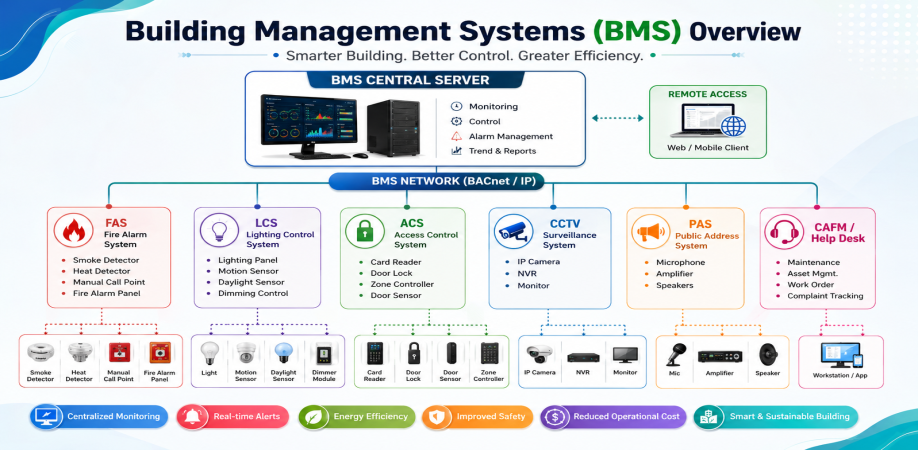
What is a (BMS)?
A Building Management System (BMS) is an intelligent automation and monitoring platform that controls, manages, and optimizes a building's essential systems from a centralized interface. It integrates HVAC, electrical systems, lighting, fire safety, security, access control, energy management, and other critical building operations to improve efficiency, safety, and comfort.
Modern BMS solutions help facility owners and managers reduce energy consumption, minimize operational costs, enhance occupant comfort, and ensure seamless building performance 24/7.
What Does the (BMS) Do?
Climate Control
Maintain the perfect indoor environment with intelligent HVAC management. The BMS continuously monitors temperature, humidity, and air quality, automatically adjusting heating, ventilation, and air conditioning systems to maximize comfort while reducing.
Smart Lighting
Optimize energy usage with automated lighting control. The system adjusts lighting based on occupancy, daylight availability, and predefined schedules, ensuring efficient illumination while lowering electricity costs and supporting sustainability goals.
Safety & Security
Protect people and assets through integrated security management. The BMS connects with access control systems, CCTV surveillance, fire alarm systems, and emergency response solutions to provide real-time monitoring, instant alerts, and enhanced building safety.
Energy Management
Track and analyze energy consumption across the facility. The system identifies inefficiencies, generates performance reports, and helps reduce operational costs through intelligent energy optimization.
Equipment Monitoring
Monitor critical building equipment such as pumps, generators, electrical panels, and chillers in real time. Automated alerts and predictive maintenance features help prevent unexpected downtime and extend equipment lifespan.
Centralized Building Control
Manage all building systems from a single dashboard. Facility managers gain complete visibility and control over operations, enabling faster decision-making and improved overall building performance.
Why Use a BMS?
Improve Efficiency, Reduce Costs, and Create Smarter Buildings:
A Building Management System (BMS) is essential for modern facilities that require efficient, secure, and sustainable operations. By integrating and automating building systems, a BMS provides centralized control, real-time monitoring, and intelligent decision-making that improves overall building performance.
-
Lower Energy Costs
A BMS continuously monitors and optimizes HVAC, lighting, and electrical systems to eliminate energy waste.
-
Predictive Maintenance & Fewer Repairs
The system monitors equipment performance in real time and detects potential issues before they become costly failures.
-
Better Indoor Air Quality
Advanced sensors monitor temperature, humidity, ventilation, and COâ‚‚ levels to maintain a healthy and comfortable indoor environment. Improved air quality enhances occupant well-being, productivity, and regulatory compliance.
-
Enhanced Safety & Security
A BMS integrates fire alarm systems, CCTV surveillance, access control, and emergency response systems into one centralized platform. Instant alerts and automated responses help protect people, assets, and critical infrastructure.
-
Centralized Building Control
Facility managers can monitor and manage all building operations from a single dashboard. This improves operational visibility, simplifies management.
-
Improved Sustainability
By reducing energy consumption and optimizing resource utilization, a BMS helps organizations achieve green building certifications and environmental sustainability goals.
-
Real-Time Monitoring & Reporting
Access detailed performance reports, energy analytics, and system alerts to make data-driven decisions and continuously improve facility operations.
Benefits of a BMS
Core Components of the (BMS)
These core components works together to improve operational efficiency, reduce energy consumption, enhance occupant comfort, and strengthen building safety.
1. Sensors
Collect data from temperature, humidity, pressure, occupancy, and energy usage.
2. Controllers
Process information and execute automated control actions.
3. Communication Network
Connects all devices using protocols such as KMC Controls, DALI, KNX.
4. User Interface (HMI)
Provides centralized monitoring and control dashboards.
5. Software Platform
Analyzes data, generates reports, and supports smart decision-making.
BMS System Design Process
Delivering Intelligent Building Automation from Planning to Performance
01. Site Assessment
Evaluate infrastructure, HVAC, electrical systems, and project requirements to build a customized BMS strategy.
02. System Design
Develop SLD, network architecture, and control logic for scalable and energy-efficient solutions.
03. Integration
Integrate HVAC, lighting, fire alarm, CCTV, and smart systems seamlessly.
04. Maintenance
Provide monitoring, updates, optimization, and long-term technical support.
BRAND Partners:
Industry-leading building automation and HVAC control solutions.
Global standard for smart building automation and control.
Advanced IoT-based smart home and smart building solutions.
Digital Addressable Lighting Interface for intelligent lighting control.
Major Footprints (BMS)
Transforming Buildings Through Intelligent Automation
Energy Efficiency & Sustainability
Occupant Comfort & Productivity
Safety & Security Management
Operational Cost Reduction
Centralized Monitoring & Control
Asset Protection & Equipment Reliability
Data Analytics & Smart Reporting
Regulatory Compliance
Applicable Sectors of BMS
Our Building Management System solutions are designed to improve comfort, efficiency, safety, and centralized control across modern commercial and industrial environments.